Bit #25: Why build a mullet data center?
Daily update, October 12, 2026: the motivation for the project, and the talk I gave at TABConf 8
Today I gave a talk at TABConf 8 called "Bringing the mullet data center to life". After the talk, several people asked me to write about the work as it happens. I started this series of posts for them. I will post a short update on each day that I work on the project. This first post explains why the project exists.
The talk
- Event: TABConf 8, at the Georgia Tech Exhibition Hall in Atlanta.
- Time: Monday, October 12, 2026, from 12:45 to 1:00 PM.
- Room: the Hacker room.
- Listing: the talk is on the TABConf 8 schedule under my GitHub name, Dr M Robotix. The proposal is issue #45 in the conference repository.
- Slides: download the slides as a PDF (18 slides, 5 MB). The last slide of this copy lists my contact page in place of my email address. Every other slide is the version I presented.
What a mullet data center is
A mullet data center is one site that holds two kinds of computer. Both kinds draw power through the same grid connection. The first kind is GPUs running AI for paying customers. Those customers have contracts that set how fast the GPUs must answer, so the GPUs get power first. The second kind is Bitcoin miners. The miners use whatever power the GPUs are not using. The miners can also reduce their power when the GPUs or the grid need it.
The name comes from the haircut, which is described as business in the front and party in the back. The AI is the business in the front. The miners are in the back. Hashrate Index published a written overview of the idea on March 18, 2026.
Why miners are becoming AI hosts
The April 2024 halving cut the Bitcoin block reward in half, to 3.125 bitcoin. The revenue that a mining machine earns fell with it. At the same time, AI companies need sites with large grid connections. Bitcoin miners already own such sites, with land, substations, power contracts and cooling in place.
Several public mining companies have signed contracts to host GPUs. Core Scientific, for example, has committed up to 800 MW of its capacity to AI hosting through CoreWeave. These contracts pay a fixed amount for several years. Mining revenue changes with the bitcoin price and with the network's difficulty.
Most of these conversions remove the miners and install GPUs in their place. Very few sites keep both kinds of computer on one grid connection.
Why the grid cares
New data centers wait years for a grid connection. In 2025 the Duke Nicholas Institute published Rethinking Load Growth. The report estimates how much new load the US grid could connect if that load agreed to reduce its power on request. It measures the reduction as a share of the energy that the new load could use in a year. These are its main findings:
- If new loads give up 0.25% of their potential annual energy, the grid could connect about 76 GW of them. That is about 10% of US peak demand.
- At 0.5% of energy, the figure rises to 98 GW. At 1% it rises to 126 GW.
- The report also gives the number of hours a year in which some reduction is needed, averaged over the 22 grid regions it studied: about 85 hours at 0.25%, 177 hours at 0.5% and 366 hours at 1%. In most of those hours the reduction is partial.
- The average reduction event lasts between 1.7 and 2.5 hours, depending on the annual limit.
- In nearly 90% of the hours with a reduction, at least half of the new load keeps running.
The main reward for a flexible site is therefore an earlier grid connection. Payments for reducing power during grid events are a smaller benefit. The reductions the grid asks for are also short, and most of them are partial.
Why miners can reduce power on request
Bitcoin miners have three properties that suit them to this role:
- When a miner stops, no customer is left waiting. The operator loses only the revenue the miner would have earned during that time. When an AI server stops, its users get no answers.
- Mining software can reduce a miner's power quickly. Luxor, for example, publishes that its curtail command takes a miner down to about 25 W in under 5 seconds, and that restoring it takes under 10 seconds.
- Above a break-even electricity price, mining loses money. Miners therefore already have a financial reason to stop when power is expensive. Power prices are usually high when demand on the grid is close to the available supply.
My earlier research measured this behaviour at 21 mining facilities in the United States and Canada.
Why mullet data centers are rare
In the talk I gave four reasons:
- AI power changes in under a second. For the miners to offset those changes, they have to change their own power at a comparable speed. Nobody has published how long a mining chip takes to settle at a new power level after a change in its clock frequency.
- AI pays more per megawatt. An operator earns more from a megawatt leased to an AI tenant than from the same megawatt used for mining. Operators who convert a site therefore usually give all of it to AI.
- The buildings are different. AI tenants expect backup power, redundant power feeds and dense cooling. Mining sites are usually built without them.
- No published method decides which fleet reduces power. In August 2026, Luxor, which sells software for miners, and Bentaus, which sells software for GPUs, reduced a GPU inference load to about 25% of its normal power in under 500 ms in response to a grid signal. Each company's product controlled only its own fleet. BlueFlare states that its BALA software balances AI inference with mining at each of its sites. Those sites run on their own gas supply at a fixed price, and BlueFlare has published no method or measurements. Nobody has published a method, or a measured result, for a site that is connected to the grid and pays changing power prices.
My research addresses the first reason and the fourth.
The approach I am testing
A site like this has three ways to change its power, and each works at a different speed:
- Capacitors respond in well under a second, but they store little energy.
- Bitcoin miners respond in seconds. They represent a large amount of power that costs little to reduce.
- Moving AI work to another time can reduce the site's power for minutes to hours, but the customers notice the delay.
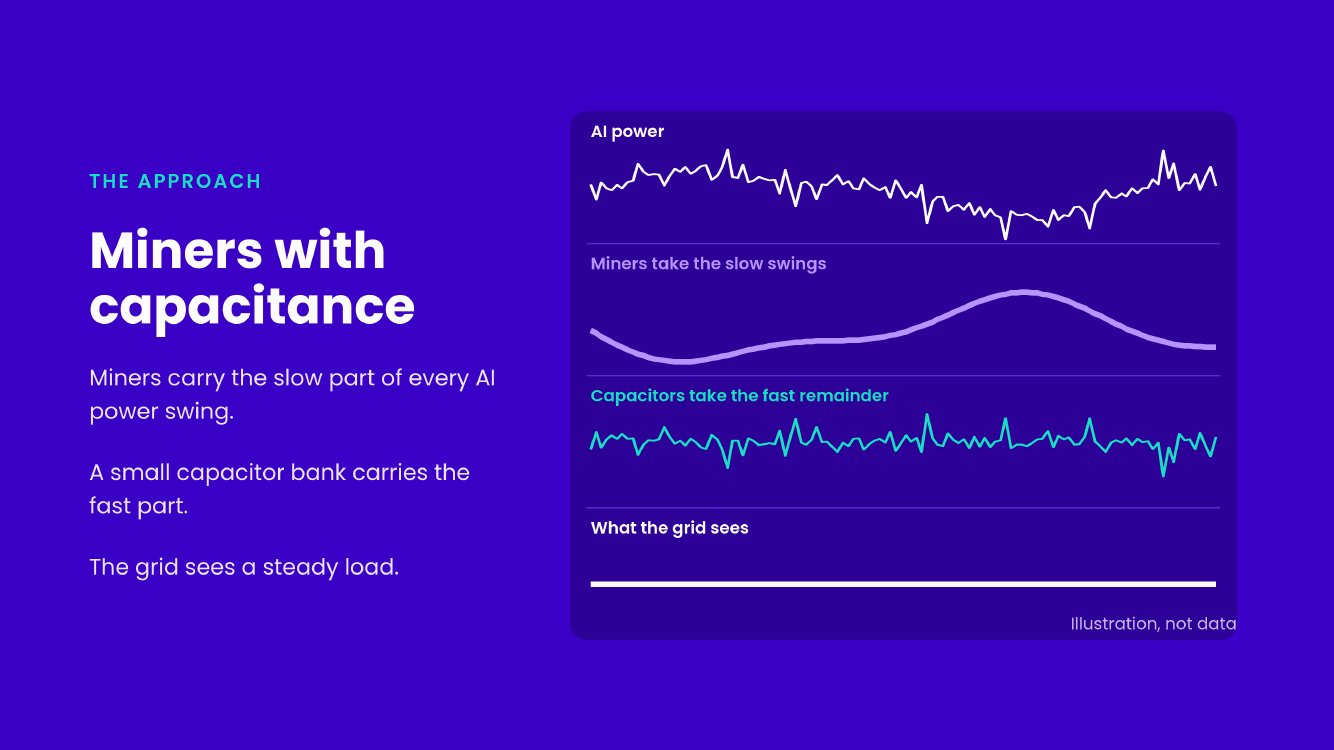
The approach I am testing combines the first two: capacitors and miners. The AI's power changes over time. When the AI's power changes slowly, over seconds or longer, the miners change their power by the same amount in the opposite direction. When the AI's power changes faster than the miners can respond, a capacitor bank supplies or absorbs the difference. The sum of the AI's power, the miners' power and the capacitor bank's power is a steady load at the grid connection. Because the miners handle the slow changes, the capacitors only need to store a small amount of energy.
What I have done so far
I have run two experiments, and each has its own post:
- The first experiment measured how fast the power of an AI GPU changes while it serves requests timed like real traffic. It is finished.
- The second experiment measures how fast a Bitcoin mining chip's power changes after a command. It is still in progress.
The mining firmware for the second experiment is a modified version of Mujina, the 256 Foundation's open-source Bitcoin mining firmware. A grid operator that relies on a load to reduce its power needs to know how that load will respond. Most miner firmware is closed. Nobody outside the vendor can check how closed firmware controls power. Anyone can read the code in open firmware that controls the chip, and anyone can test it.
