Bit #18: “The Trophic Theory of Money” — Radical System Change: Bitcoin & Degrowth — Issue #10
Originally published on Medium on July 27, 2022.

Just thoughts on the connection between bitcoin and elements of the “degrowth” movement that argues that never-ending economic growth is leading us toward an unsustainable and ecologically destructive path.
I’m mostly back from a very needed vacation. Before getting into this issue’s topic, I want to share my recent appearance on the Progressive Bitcoiner, with Mark Stephany. This is my favorite podcast appearance so far. We spent a lot of time on degrowth, so I highly recommend it.
The Progressive Bitcoiner Episode #29: https://theprogressivebitcoiner.com/episode-29-new-yorks-pow-bill-degrowth-and-the-value-of-bitcoin-with-margot-paez/
The UK Bitcoin Collective invited me to speak at their UK Bitcoin Conference later this fall and of course, I said yes. I’m raising money to help pay for my fare and hotel stay. I have 8.3K Twitter followers, if only 5% of you contributed 22K satoshis (~5 dollars), I would easily reach my goal. If you think the work I’ve been doing with the Bitcoin Policy Institute, through my writings on here and Twitter, and through the various podcast appearances have been useful, then please consider sending some sats my way.
My UK Conference TallyCoin Fundraiser: https://tallyco.in/s/qq1yuz/
—
I’m nearly done reading Supply Shock by Brian Czech. Whenever I read degrowth-related literature I always brace myself for the possibility that I’m going to read something that contradicts my view that degrowth aligns with bitcoin. Once Czech got into the details of ecological economics, one of my legs started bouncing and my teeth clenched. I was nervous!
Thankfully, I didn’t find any obvious contradictions. Even when he went into the details of trophic money, I found myself nodding along in agreement. Czech wrote a lot more than I expected on the subject of inflation and its causes and I could have sworn this guy was a bitcoiner! So, I want to get into this a bit more, because I think we’re really onto something.
In ecological economics theory, the economic system can be understood through the trophic structure of the human economy. Trophic is a concept taken from ecology, which describes the flow of energy and nutrition through a system. I’m giving a brief overview, for more details check out CASSE’s pamphlet.
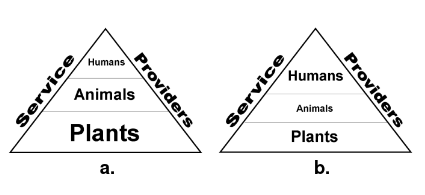
In the trophic structure, agriculture and extraction such as logging, fishing, and mining are at the base level of the pyramid. Though we can make some gains through efficiency improvement, these resources are still finite. From here, the rest of the economy is built.
From an ecological economics perspective, money is a result of agricultural surplus. Czech writes that without this fundamental surplus there is no use for money because the division of labor would be impossible. The more money an economic system has, the more surplus is necessary and the more environmental impact our system has. This is the trophic theory of money.
Czech explains, “So the trophic theory of money helps to explain why there is a fundamental conflict between economic growth and environmental protection, and why that conflict cannot be solved by throwing evermore money at it.”
The tropic theory of money is also useful for explaining inflation. Most bitcoiners refer to Austrian economics for a dissection of inflation and money supply, but it’s not the only economic school that sees the connection. This opens up the possibility for alternative perspectives on bitcoin and I hope this will help broaden our understanding and allow us to formally root bitcoin within the ecological systems-thinking framework.
From the trophic theory perspective, “The monetary authorities and banks can extend credit and expand the money supply all they want, but if the capacity of the planet to generate more real money has been exceeded, credit leads to default, and the expanded money supply becomes “unreal” or inflated.”
If real money (money that is tied to real production and real wealth) has a limit because there is a natural ecological limit, then it makes sense that bitcoin should have a monetary limit. The monetary limit is not just “number go up technology”, it’s keep-our-species-from-outgrowing-the-planet’s-capacity technology, too. The latter being bitcoins’ most important technological innovation, as far as I’m concerned.
… Something is missing from this analysis, which is whether bitcoin’s energy use is a contradiction here. I don’t think it is, for reasons that I’ll have to save for the next issue.
