Bit #13: Radical System Change: Bitcoin & Degrowth — Issue #5
Originally published on Medium on May 31, 2022.
This issue’s topic: I’m still in the demurrage rabbit hole, sorry, not sorry.
Just thoughts on the connection between bitcoin and elements of the “degrowth” movement that argues that never-ending economic growth is leading us toward an unsustainable and ecologically destructive path.
Last week, I introduced the idea of demurrage currencies. My goal was to explore how it related to bitcoin and degrowth. Since demurrage is designed to (hypothetically) eliminate interest and inflation, it overlaps with bitcoin’s role in helping us produce a planet-friendly and sustainable economic system.
There are a couple of ways to implement such a currency using bitcoin. However, before I get into that, I want to spend one more newsletter on exploring a real-world, 21st-century application of a complementary demurrage currency. So, I’m holding off until next week to discuss the dangers of demurrage currencies and how a bitcoin implementation eliminates that danger.
Demurrage currency is one where the value of a currency in circulation diminishes over time, at a predictable rate. Zakat is a form of Islamic demurrage where a small percentage of your wealth is collected and then effectively redistributed to those in need or toward other socially beneficial investments. Depending on where you live in the Muslim world, either the state collects this holding fee and/or regulates it, or a local religious center does.
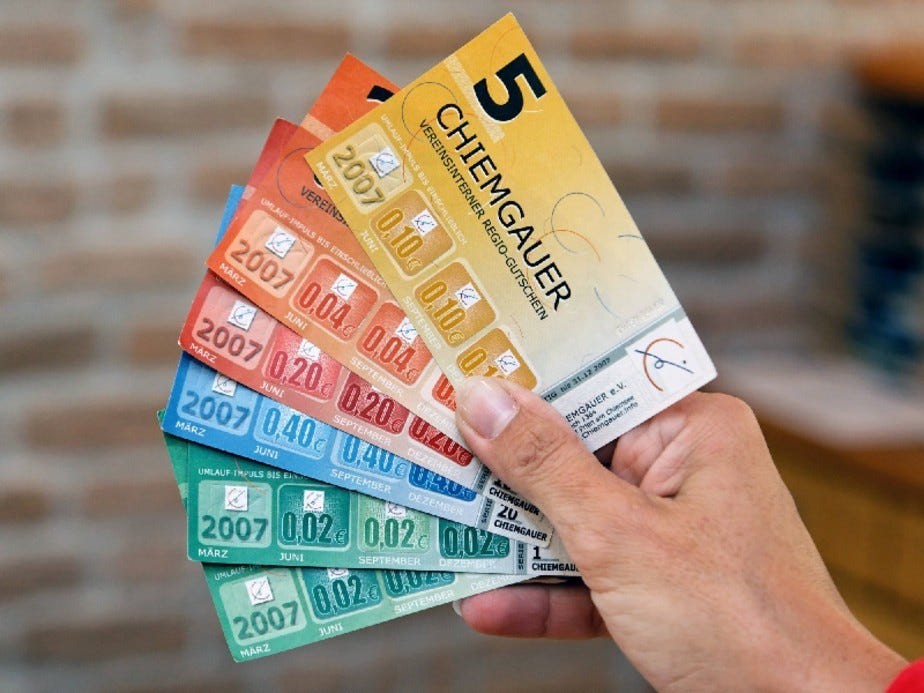
The best modern example of this type of currency is in a region of Bavaria, Germany. Chiemgauer is a complementary and regional currency that, when in circulation, expires after three months. The holder pays a small 2-percent fee to revive the expired notes. The demurrage, as discussed, is then reinvested into the community. Anyone holding chiemgauer can exchange it back into euros (1 chiemgauer = 1 euro, psst…it’s a euro-backed stablecoin) for a small exchange fee of 3-percent. The person who exchanges out of chiemgauer and into euros can choose a non-profit that will receive the fee as a donation.
The region also has a cooperative that acts like a savings account, where holders of chiemgauer can deposit their currency at zero interest. This is like a loan, because the cooperative promises to return it to you at 100-percent face value. In this way, you avoid the quarterly depreciation and are rewarded for not holding the currency. Chiemgauer can also be lent out (perhaps from these very cooperatives?) for local investment. To minimize risk, the regional currency is lent out at 7-percent interest, but if the person holding the loan pays it back on time, the interest is returned in full.
Other well-designed incentives encourage businesses and non-profits to participate and accept the currency. For brevity, I will leave this up to the reader to investigate further at the P2P Foundation’s wiki entry (click the link for more information).
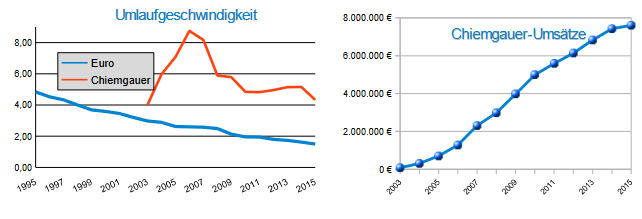
The statistics from the chiemgauer website suggest that circulation of the currency is overall faster than the euro. Early adoption had a very high velocity in comparison to the euro. Since then, the trend in circulation rate has decreased back to its 2005 velocity. Unfortunately, the data only goes to 2015, so we have no idea whether circulation has continued a downward trend or stabilized around its initial 4-times the velocity of the euro.
Obviously, there are incredible benefits to demurrage for a regional currency and especially so when it is a complementary currency. That is, a currency that does not replace a dominant one, but pairs alongside it. The number of opportunities to keep a portion of profits within the community is wide. Also, nothing stops a holder of that currency from exchanging out into another currency that has a better store of value. In addition, it gives monetary power back to the community and allows the people of this region to determine where investments should go. I think it is obvious that something like this would be a useful addition to the bitcoin network (the recent 1 BTC bounty for stablecoins on bitcoin suggests as much).
There are concerns with demurrage, though. While Kennedy writes that such a currency would not be inflationary, I did notice in the Wikipedia entry that the currency supply has increased over time even though business and user participation has leveled off. There’s very little information available online to explain why the community has chosen to grow its currency supply. My guess is that the euro is still the unit of account. At any rate, there’s bigger worries about this type of currency, though.
Next week we’ll look at how central banks took inspiration from Gesell and are now experimenting with negative-interest rates. With the trend toward CBDCs as a competitor to bitcoin, there’s a lot to be worried about…
