Bit #21: “Energy” Part 1 — Radical System Change: Bitcoin & Degrowth — Issue #12
Originally published on Medium on August 12, 2022.
Just thoughts on the connection between bitcoin and elements of the “degrowth” movement that argues that never-ending economic growth is leading us toward an unsustainable and ecologically destructive path.
I finished Part 1 of John Peet’s Energy and the Ecological Economics of Sustainability and what follows are my thoughts on this introductory section of the book. Thank you to everyone who supported my conference fundraiser, I reached my goal and I’m all set for the trip!
Peet’s book was published in 1992 but it’s still relevant to the ecological issues we face today, simply because our societies have not made serious attempts to address these issues. Issues like resource depletion and environmental degradation due to resource extraction have changed little since this book was written.
The book is in three parts. Part 1 is called, “Nature: The World as We See It” and it goes through the scientific foundations of energy and what he refers to as the “political-economic” view of energy, which is one where the economy is isolated from the rest of the world. He also introduces something called, “systems thinking” and the “biophysical systems world view”, which attempts to combine the ecological/scientific view of energy with that of the standard economic view. All of this is introductory, to prepare the reader for the following parts.
I found the maximum power principle to be an interesting test of bitcoin’s resiliency. Evolutionarily, “those systems that survive in the competition among alternative choices are those that develop more power inflow and use it best to meet the needs of survival.” Is there anything that we can glean from this in terms of PoS versus PoW?
Throughout Part 1, Peet is fairly critical of the failings of neoclassical economics. He argues that neoclassical economics treats the environment as a limitless reservoir for energy and resources and a limitless sink for waste. In neoclassical economics, there is a belief that there is no limit to technological innovation that makes this limitlessness true. Peet argues that this is exactly incorrect. The foundation for his claim is that the second law of thermodynamics prevents perfect efficiency of energy use. He writes that no innovation creates a perpetual motion machine and no innovation can create a car that runs forever using water as fuel (water is considered a degraded product of combustion).
Even with 100% efficiency, there is a tradeoff in power output. a perfectly efficient machine would operate infinitely slow and produce zero power output. Instead, there’s a sweet spot around 50–66% efficiency versus power output (although most machines never reach this). This means that there will always be degraded energy that cannot be used. Therefore, technological innovation has its limits. From the neoclassical concept of economic growth which relies on technological innovation, that means that economic growth has its limits, too.
He also introduces a concept called, “the time value of money”. This should sound very familiar to a bitcoiner because it highlights the problem with high-time preference.
The economic treatment of time is bound up with the idea that a dollar in the hand today is worth more than a dollar in the hand in, say, a year’s time. One can use today’s dollar now to create additional wealth. If one invests the dollar, it will earn interest and will be larger after a year than a dollar kept under the mattress…Social time preference reflects the idea that most private decisions are believed to neglect the need to take account of future generations. In other words, individuals are seen as always acting in such a way as to maximize their current personal utility.
Peet uses this concept to show how we discount things, like environmental resources, which are discounted in the future so that it makes more sense to use them now, rather than save them for future generations.
He also talks about how our economic system is a dissipative structure, an open system that is far from thermodynamic equilibrium. Open systems exchange both energy and matter (such as waste) with their surrounding environment. He suggests that maybe this partly accounts for the business cycle of stability and instability. Do you think bitcoin is a dissipative structure?
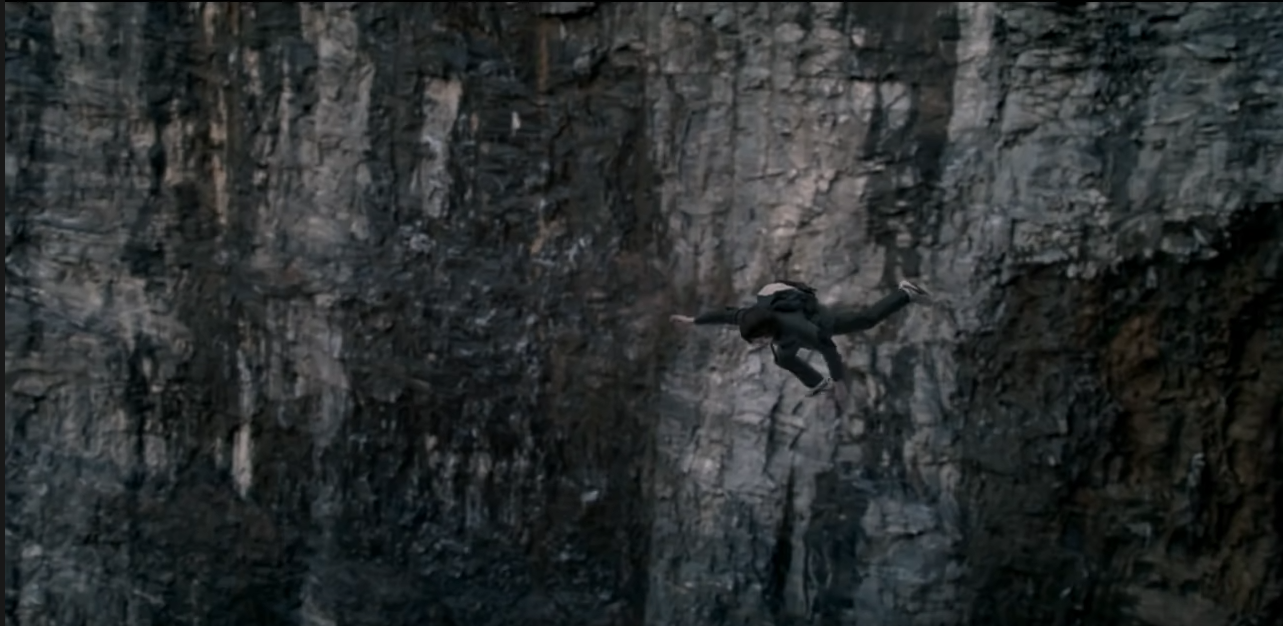
I used a still from Stranger Things to highlight a fact about the second law of thermodynamics which is that some systems are energetically irreversible. The best example is dropping a plate on the floor and it breaks into many pieces. You cannot play time in reverse and make the plate reform. The only way you can do that is if you have a friend with super powers that can bend the laws of gravity and entropy. This is one of Peet’s main points: when we use a high-grade energy source, we deplete it (inefficiently) and its byproduct is low-grade energy (like heat that dissipates from a resistor) that cannot be converted back into the high-grade version that it started as. This happens across all strata of the ecological pyramid. Humans, no matter how ingenious we may believe we are, cannot defy this basic fact.
…But, we can make use of that low-grade heat if it’s of high enough temperature! Bitcoin mining heat capture and use is one way of doing that.
I’ll share more thoughts on Energy and the Ecological Economics of Sustainability in next week’s newsletter!
