Bit #22: Cryptocommunism?! — Radical System Change: Bitcoin & Degrowth — Issue #13
Originally published on Medium on August 17, 2022.
This week’s issue is an tourist’s review of the book Cryptocommunism. Did your head explode immediately after reading the word, “cryptocommunism”? I will return to my review of “Energy and Ecological Economics” next week.
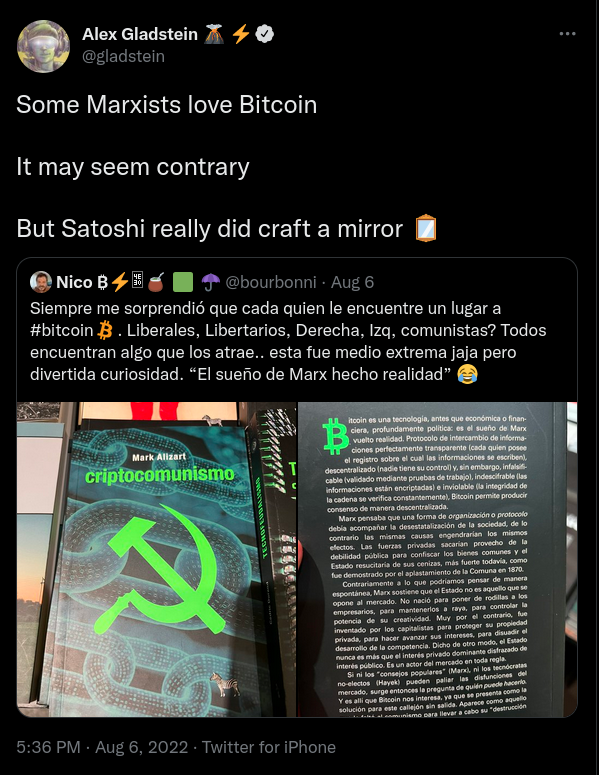
I’m not sure how many saw Alex Gladstein’s recent tweet about a book called, Criptocomunismo. A book that explains how bitcoin is the missing tool for making communism work. I mentioned this book to a friend and they told me there’s an English language book with the same title, Cryptocommunism by Mark Alizart. Turns out they’re the same book!
You might be wondering what this has to do with bitcoin, many people do not believe that you can say bitcoin and communism in the same sentence without including the word “opposed” in between the two. Alizart argues the opposite. Unfortunately, the epub copy that I found online is only a preview of the first two pages of each chapter in the book. Still, there’s a chapter in there called, “thermocommunism” that sounded a lot like what I’ve been writing about recently regarding ecological/degrowth economics. So, as a slight detour from Peet’s book, let’s find out what “thermocommunism” is…
Alizart writes about the message in bitcoin’s genesis block: “03/Jan/2009 Chancellor on brink of second bailout for banks”. He notes that bitcoin was designed to protect “private savings from the voracity of governments, even if it meant participating in a collective effort, and above all even if it meant ‘socializing’ losses.” He continues,
However, once again, perhaps on this point libertarians may just be Marxists who don’t yet realize it, because unlike the http protocol, not only is the Bitcoin protocol a vehicle for ‘communication’, it conveys value, it is money, and therefore a powerful lever for economic action; but what Bitcoin proposes in order to avoid the arbitrary power of banks is a ‘collective appropriation of the means of monetary production’, so that one might wonder whether it is not the very instrument communism needed in order to be truly realized, even if Marx himself would probably have found it difficult to believe.
From Alizart’s perspective, Marx’s view is an extension of the laws of thermodynamics as applied to society and economics. Ecological economics, of course, looks at society and economics as not an extension of thermodynamics, but as naturally governed by it. Alizart argues that Marx (along with Engels) was the first to describe the economic system as being far from equilibrium. Again, this is a perspective that is well understood in ecological economics. Alizart suggests that Marx’s focus on the first law over the second law (which was incorrect) led to the belief in the abolition of private property, which was the wrong solution. The decline of the Soviet Union could even be viewed as a kind of “heat death”, because of the lack of property-ownership differential. Something akin to a temperature gradient, which would allow for heat to transfer from high to low and drives the flow of energy.
Alizart’s point is that if Marx has known about “information” in the mathematical sense, then he might have thought of overturning capitalism in terms of money, which is economic information. Interesting theory. It’s certainly true that Marx believed that replacing a currency would not fundamentally change an economic system. I’ve thought about this as well and felt that Marx’s view has historically been true before bitcoin but is no longer the case.
Even with the preview, it’s obvious that Alizart has some issues with bitcoin, in particular its monetary cap. He gets bitcoin’s revolutionary aspect, but he rejects the Austrian capture and sees a gold-like standard as being less useful than an energy standard. He also imagines (so much as I can glean from the preview) a world of a multitude of currency choices. I have to counter Alizart, though. The last 12 issues of this newsletter have been exactly an exploration of complementary currencies, including energy-backed currencies that could exist within a bitcoin standard world. I think Alizart makes three fatal mistakes (assuming he doesn’t address these in the remaining pages that are not in the preview version of the book):
- Overlooks layered protocols
- Ignores the ability to issue currencies of any kind using colored coins and Chaumian banks
- Hasn’t read John Nash’s “Ideal Money”
I think if he had paid more attention to these points, he would see that bitcoin’s design choice isn’t beholden solely to the Hayekian viewpoint, as a result of the 21 million bitcoin cap. In particular, if you wanted to create energy currencies, you could do that with bitcoin created at a miner co-located with a power plant. These bitcoin could be colored, a specified amount representing a certain amount of kWh. Of course, I wrote about this in my earliest issues of this newsletter, when I mentioned Richard Douthwaite’s degrowth writings about energy currencies.
So am I worried about a liquidity crisis due to the monetary cap? No, not really. Money creation can still happen if a society wants it. However, money creation tied to the network carries the weight of the ecological footprint of the network and represents a share of responsibility for that footprint that is verifiable on the public ledger. As Alizart astutely points out, the privatization of money creation already happened in the 1970s and it’s part of what spurred financialization. Bitcoin is not the privatization of money. Bitcoin is an open network that anyone can use. Anyone can create a community bank, anyone can issue “IOUs” through such a bank. Neither the state nor the Cantillionaires/capitalists/financiers/whatever you want to call the very rich who prop up a state to make it easier for them to be the 1-percent and the rest of us to be the 99-percent can as easily do what they’ve done with fiat, with bitcoin.
In this sense, bitcoin is a kind of cryptocommunism (not in the dictatorship of the proletariat sense but in a democratic sense). It is money of and for the commons. But as Prof. Richard Wolff pointed out in a very surprising interview, it must come with struggle and without struggle, it’s still possible for the very people we’re fighting against to capture bitcoin and incorporate only the parts they like into the existing system, effectively sterilizing its revolutionary potential. So, we struggle.
—
“Radical System Change — Bitcoin & Degrowth” is a newsletter on the connection between bitcoin and elements of the “degrowth” movement. Degrowth argues that never-ending economic growth is leading us toward an unsustainable and ecologically destructive path.
